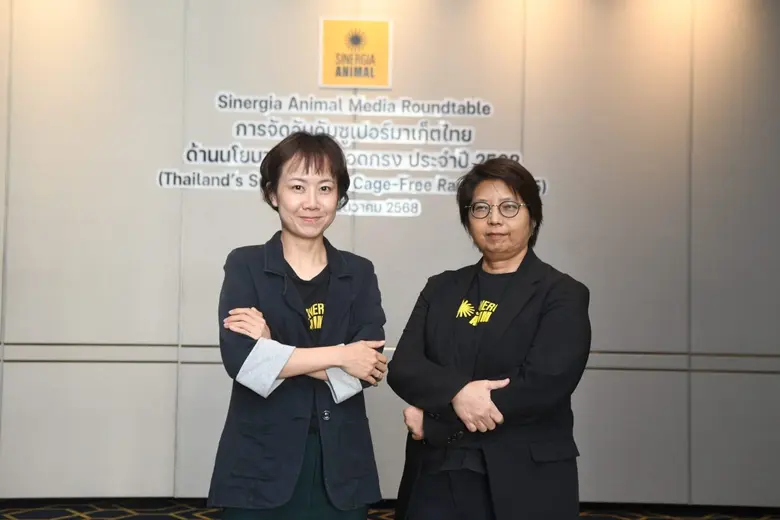
This landmark ranking aims to elevate public awareness, drive corporate accountability, and accelerate Thailand's transition toward humane and sustainable food systems. The assessment—based solely on publicly available information—highlights both promising leadership and significant gaps within the country's retail sector.
Key Findings
The evaluation, based on six criteria with a maximum score of 18 points, reveals that only five out of fourteen retailers have published policies or demonstrated initiatives related to cage-free egg sourcing.
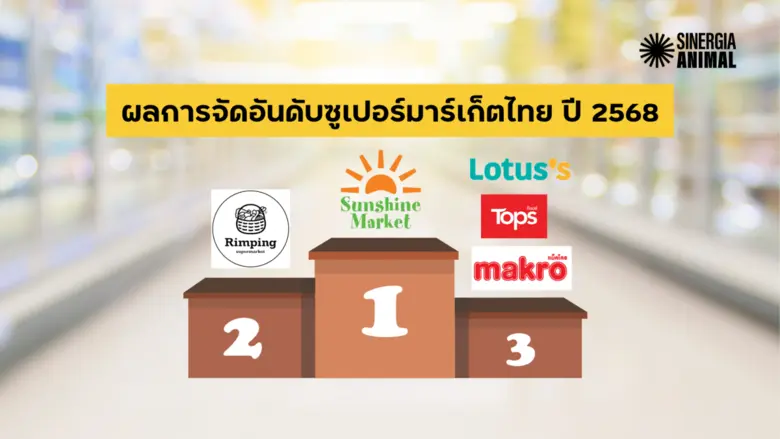
The top performers are:
- Sunshine Market - 83% (Rank A), with a strong public policy covering all brands and branches, including a clear transition timeline.
- Rimping - 72% (Rank A), with comprehensive coverage and commitments supported by an official declaration.
- Tops, Makro, and Lotus's - each scoring 55% (Rank B), reflecting partial progress and defined transition periods, though gaps remain in coverage and reporting.
Meanwhile, several large-scale and influential retailers including 7-Eleven, Big C, Villa Market, Foodland, Lawson 108, MaxValu, and Gourmet Market received a score of 0%, indicating no publicly available cage-free sourcing policy.
A Wake-Up Call for Thailand's Retail Leaders
Thailand currently has over 54 million hens confined in battery cages, many restricted to less space than an A4 sheet of paper. Such extreme confinement deprives hens of basic natural behaviors such as wing stretching, nesting, or dust bathing.
"This ranking provides a clear, data-driven picture of where Thailand's retailers stand in their cage-free commitments. While some companies demonstrate promising leadership, the overall landscape shows considerable room for improvement. Retailers play a pivotal role in shaping responsible markets, and their sourcing policies must reflect this responsibility." Saneekan Rosamontri, Managing Director, Sinergia Animal Thailand
Partial Progress Is Not Enough
The ranking also uncovers striking inconsistencies within major corporate groups. For example, while Makro and Lotus's, under CP Axtra, scored relatively well, the group's affiliated company CP All, which manages 7-Eleven, has no public cage-free policy, reflecting a lack of unified standards within the same corporate ecosystem.
"Retailers, regardless of size, can make measurable progress by setting clear timelines, ensuring comprehensive coverage, and reporting transparently. Incremental steps, when implemented consistently, can transform industry standards and consumer expectations." Hatai Limprayoonyong, Manager of Programs, Sinergia Animal Thailand
A Global Imperative
Countries such as Switzerland, Austria, Luxembourg, Iceland, and several others have already enacted bans on battery cages, while leading international companies have committed to eliminating cages from their supply chains worldwide.
"Moving toward cage-free sourcing is aligned with global best practices and is increasingly expected by consumers, investors, and regulators worldwide. Thailand's retail sector now has an opportunity to demonstrate leadership in Southeast Asia by adopting unified, time-bound cage-free commitments." said Carolina Galvani, Executive Director, Sinergia Animal.
A Call for Unified Action
Sinergia Animal urges Thailand's major retailers and convenience store chains to adopt sector-wide cage-free commitments, especially those with large market shares and influence. By doing so, they can help shift the entire industry toward a more humane, sustainable model.
The full Supermarket Cage-Free Ranking 2025 is available at: https://www.breakingfreefromcages.com/