Dataxet Limited, a leading media intelligence company, has released the Thailand Media Landscape 2025-2026 report. The comprehensive study compiles statistical data, survey findings, research insights, and in-depth interviews with industry experts to equip media professionals, marketers, and business leaders with the strategic intelligence needed to navigate emerging challenges and seize new opportunities.
AI in the Newsroom and the Reinvention of Search
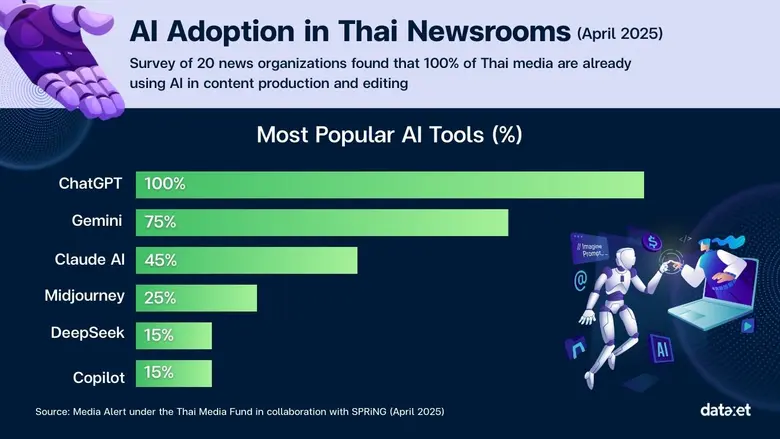
A survey of media organizations reveals that 100% of respondents have already integrated AI into their workflows. The most widely used tools include ChatGPT (100%), Gemini (75%), and Claude AI (45%). While AI significantly enhances operational efficiency, human oversight remains indispensable, with editorial teams continuing to perform final content verification prior to publication.
Meanwhile, the rise of AI-powered search and Google AI Overview has led to a marked decline in news website click-through rates (CTR). As AI-driven search engines prioritize trusted sources, credibility has become the industry's most valuable currency. Producing original, high-quality journalism not only strengthens audience loyalty but also increases the likelihood of being cited by AI systems—emerging as a new form of reputational capital in the digital era.
Video and Communities Dominate Social Media
Social media remains central to Thailand's digital life, with 56.6 million user accounts—equivalent to 79.1% of the population. Today's social behavior is no longer platform-centric but content-centric, shifting according to format preferences: short-form videos on TikTok, long-form viewing on YouTube, and so forth.
Nearly two-thirds of Thais aged 18-34 rely on social media as their primary news source. Notably, Thailand stands among the few countries where more people prefer to watch online news (43%) rather than read it (32%), solidifying video as the default content format of the era.
Amid the shift from fragmentation to atomization—where audiences cluster around highly specific interests—traditional platforms such as Facebook and LINE are evolving from communication tools into dynamic community and engagement hubs.
Influencers and Live Commerce in the Creator Economy
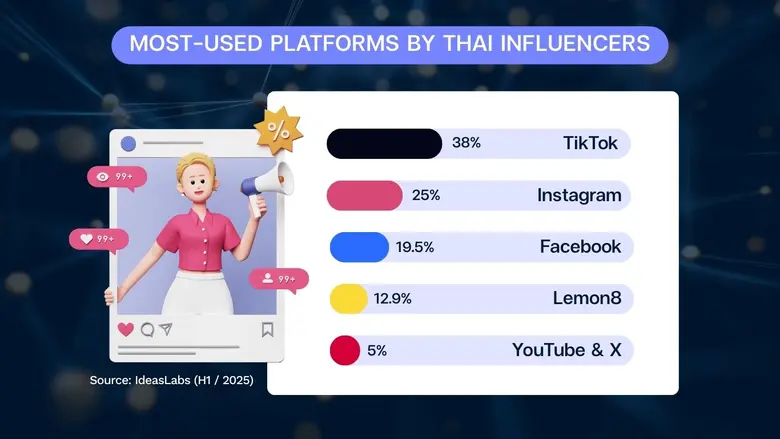
Thailand's influencer marketing industry is projected to reach USD 180.23 million by 2030. Micro- and nano-influencers command a combined 71.5% market share, reflecting growing consumer trust in smaller, more relatable creators. Brands are increasingly investing in these influencers, whose authenticity and accessibility often translate into stronger purchasing influence than that of mainstream celebrities.
The "Jenny Festival" phenomenon further underscores the explosive growth of live commerce and affiliate marketing, generating substantial revenue for both brands and influencers. It highlights a fundamental shift in distribution power—from platforms and traditional media to creators capable of building fully integrated business ecosystems of their own.
Gaming, Streaming, and Podcasts Compete for Attention
Approximately 77.9% of Thai internet users play video games, averaging 8 hours and 53 minutes per week. For Gen Z and Gen Alpha, gaming is not merely entertainment but a social arena and identity-building space. As a result, gaming has emerged as a powerful marketing channel that brands can no longer afford to overlook.
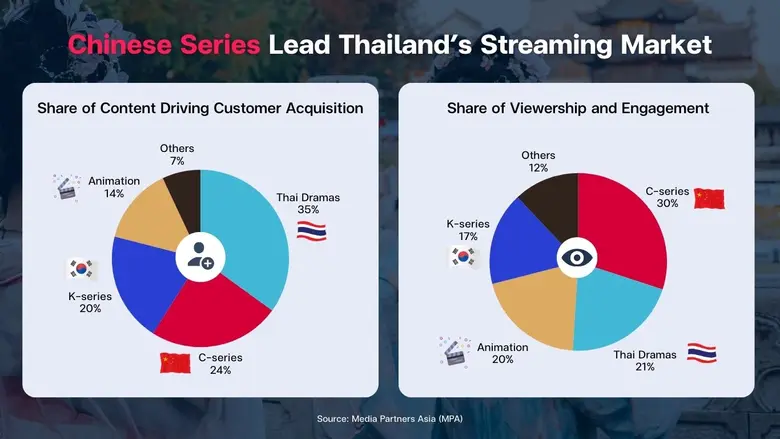
Streaming platforms are equally influential. Some 70.7% of Thai internet users watch television via streaming services, spending an average of 4 hours and 35 minutes per week. Streaming accounts for the largest share of monthly online content spending at 33.2%. Thailand has also become ASEAN's largest subscription video-on-demand (SVOD) market, propelled by distinctly Thai content—particularly BL and GL series, which command 53% of the Asian market share and have been licensed in over 190 countries worldwide.
Podcast consumption is also accelerating. Thais now spend an average of 2 hours and 23 minutes per day listening to podcasts, up from 1 hour and 1 minute in 2024. YouTube serves as the primary podcast platform for Gen Z, with usage as high as 89.75%, underscoring the medium's evolution from audio-only to a multi-platform format that audiences can watch, share, and engage with visually.
Television's Search for Sustainability and Radio's Farewell to the Dial
Conversely, traditional television continues to face mounting pressure. Advertising expenditure is projected to decline from THB 31 billion in 2025 to THB 29 billion in 2026. Broadcasters are accelerating diversification strategies, seeking off-screen revenue streams through artist management, live events, and fandom-driven initiatives.
The year 2025 also marked a turning point for Thai radio when Tero Radio announced the closure of its operations after more than 35 years in business—signaling the definitive sunset of mass commercial radio in its traditional form.
The Thailand Media Landscape 2025-2026 report paints a vivid picture of an industry reshaped by AI-driven information abundance. In this new environment, sustainable success hinges on three enduring pillars: quality, credibility, and authentic audience relationships. In an age where AI can replicate nearly everything, humanity remains the one competitive advantage technology cannot replace.
For comprehensive insights — including detailed data, expert commentary, and forward-looking analysis — please explore the full report below:
- Full Report (English)
https://www.dataxet.co/media-landscape/2026-en - Full In-Depth Version (Thai)
https://www.dataxet.co/media-landscape/2026-th - Exclusive Interview Highlights - Thai Media Trends from 5 Experts (English)
https://www.dataxet.co/media-landscape/2026-en/thai-media-trends