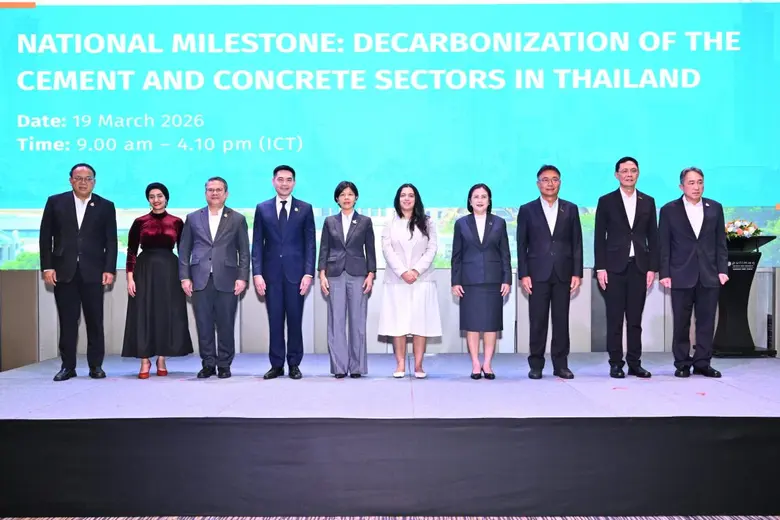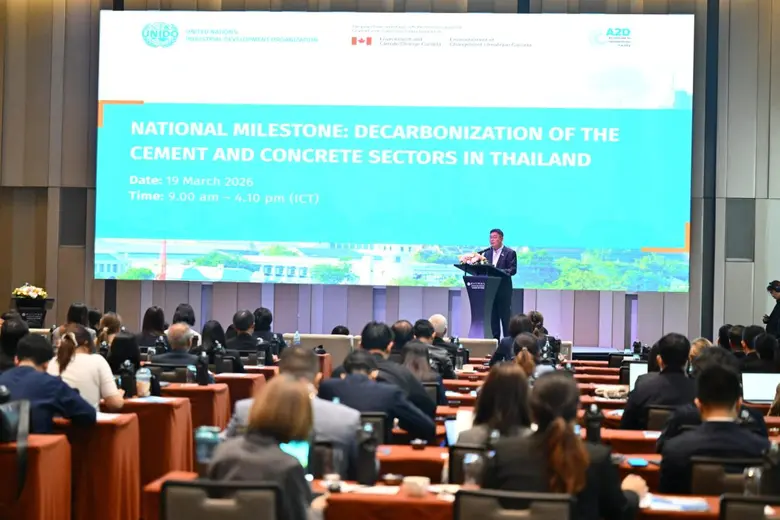
Dr. Chana Poomee, Honourary Chairman of TCMA and President of ASEAN Federation of Cement Manufacturers (AFCM), stated that today's "National Milestone" reflects the power of collaboration at both national and international levels. The initiative is led by the United Nations Industrial Development Organization (UNIDO), in partnership with TCMA and key Thai government agencies, including the Department of Climate Change and Environment and the Department of Industrial Works, with financial support of CAD 8 million from the Government of Canada through Environment and Climate Change Canada (ECCC), to accelerate tangible greenhouse gas reductions in the cement and concrete sector.
TCMA, as the industry representative, serves as a central platform connecting stakeholders across the entire value chain, driving the implementation of the "Thailand 2050 Net Zero Cement and Concrete Roadmap." This aligns with Thailand's NDC 3.0 targets, strengthening industrial competitiveness, attracting green investment, and fostering sustainable economic growth.
"Decarbonization is not only a pressing challenge but also a strategic opportunity to enhance national competitiveness. The progress achieved under this project spans policy development, innovation, technology deployment, standards, and capacity building-key enablers that will accelerate the industry's transition toward Net Zero", Dr. Chana said.
A key technological advancement under the project is the introduction of the Mobile Carbon Capture Unit (MCCU) from CETRI, Canada. This advanced and flexible technology is designed for real-world industrial operations and will be piloted starting in June, rotating across cement plants of TCMA members in the SARABURI SANDBOX. The pilot aims to validate performance under diverse operational conditions and pave the way for large-scale industrial application.
"The deployment of MCCU in Thailand highlights the strength of international collaboration in bringing advanced technologies into real-world application. It accelerates learning-by-doing, validates technological performance, strengthens local technical capabilities, and reduces investment risks-laying a strong foundation for future scale-up",Dr. Chana added.
From an investment perspective, the development of technology-ready and standards-aligned projects enhances investor confidence, increases the attractiveness of green investment, and improves access to sustainable finance-key drivers in accelerating the industry's transition to Net Zero.
TCMA continues to advance the industry under a "Collaborative Mindset-Action-Value," promoting the systematic adoption of low carbon technologies, including low carbon cement innovations such as Limestone Calcined Clay Cement (LC3), Carbon Capture, Utilization and Storage (CCUS). These solutions not only reduce emissions but also improve efficiency, lower long-term costs, and strengthen global competitiveness.
At the regional level, TCMA is expanding its role through AFCM by fostering collaboration and advancing the AFCM Decarbonization Roadmap, which serves as a shared framework to reduce carbon emissions across ASEAN's cement industry while enhancing regional technology, standards, and competitiveness.
"As President of the AFCM, TCMA is committed to driving ASEAN toward becoming a low carbon region by leveraging collaboration as a key mechanism to accelerate technology transfer, strengthen the industry capabilities, and unlock new regional economic opportunities", Dr. Chana said.
TCMA reaffirmed its commitment to strengthening collaboration and welcoming international support in both technology and finance to accelerate the transition toward a low carbon industry, while enhancing Thailand's competitiveness on the global stage.