Building on previous successes, Amata and its partners are expanding efforts to improve water and waste management near the industrial estate. Phase 4 extends the collaborative model from Klong San Taprai to include the Phan Thong Nong Kakha and Map Pong Sub-district Administrative Organizations, both neighboring the estate.
This integrated approach unites government agencies, local administrations, private-sector partners, and communities to create a scalable environmental management model, demonstrating AMATA's commitment to developing industrial cities in balance with both the community and the environment.
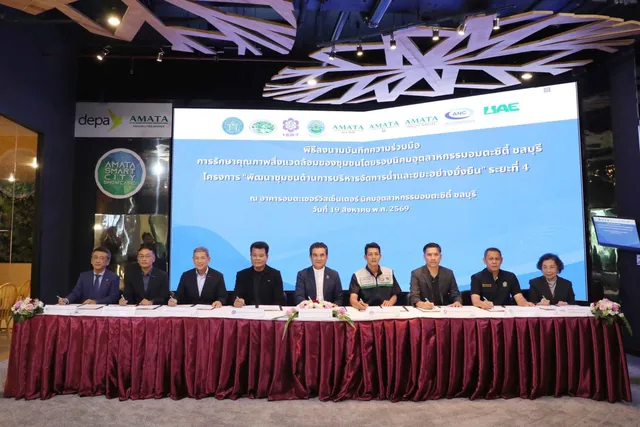
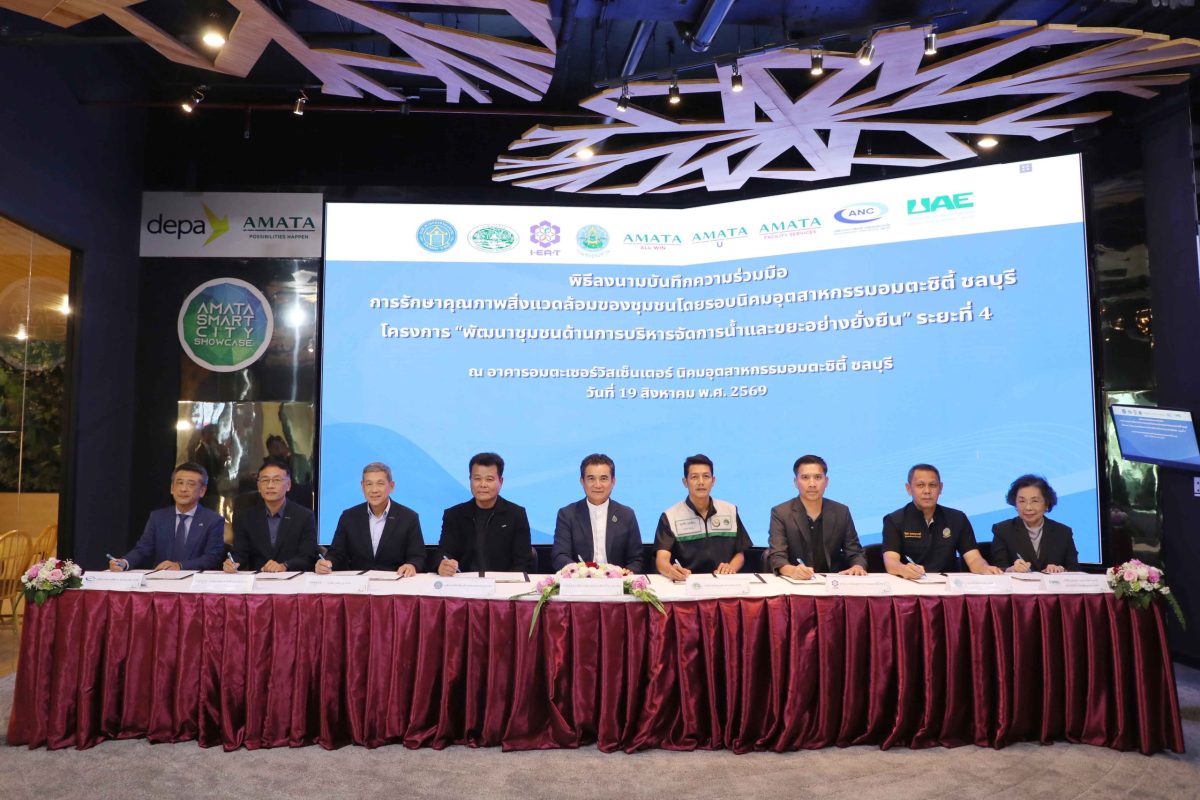
A Memorandum of Understanding was signed among nine strategic partners: Amata Corporation Public Company Limited (AMATA), Amata U Company Limited, Amata Facility Services Company Limited, the Phan Thong Nong Kakha and Map Pong Sub-district Administrative Organizations, the Industrial Estate Authority of Thailand (IEAT), Chonburi Irrigation Project, Aqua Nishihara Corporation Company Limited, and United Analyst & Engineering Consultant Co., Ltd.
Key goals of phase 4, centered on Thai Sed Canal, include restoring water quality, reducing wastewater risks, improving canal drainage, and addressing waste at the source. The project also encourages knowledge-sharing and participation among communities, local authorities, and businesses.
Dr. Viwat Kromadit, Chief Technical Officer of Amata Corporation, highlighted the partners' shared commitment to improving environmental quality and the well-being of communities near Amata City Chonburi industrial estate. He emphasized that sustainable city development extends the borders of industrial park and requires benefits for both communities and the environment, along with responsible economic growth.
" The project's true value lies in building a collaborative system for long-term stewardship. Healthy local watersheds are vital, so this phase focuses on both upstream and downstream areas of the industrial estate," Dr. Viwat said.
The project builds on the results of the previous three phases (2018-2025), which established a community-based upstream-to-downstream management model that improved water and waste management in the area.
These initiatives have enhanced collaboration among government agencies, local administrations, industrial estate developers, private enterprises, and community members in water resource management, waste disposal, canal maintenance, and fostering community involvement.
Project results are measured by tracking improvements in water quality; for example, the biochemical oxygen demand (BOD) in a particular watershed dropped significantly after the project began. Amata U maintains ongoing water quality monitoring through regular laboratory sampling and testing. Currently, solar-powered aerators and aquatic plant cultivation in selected watershed areas continue to deliver lasting benefits. In waste management, over 2,000 individuals—including market vendors and students—have received training.
Mr. Chavalit Tippavanich, CEO of Amata U Company Limited, noted that involving the community throughout, from problem identification to stewardship, is essential, as no single agency can achieve sustainable environmental management alone.
Amata U, the group's utilities arm, will coordinate efforts across sectors, manage the area, and foster community participation.
All parties will collaborate by sharing information, educating about wastewater and waste management, organizing awareness activities, monitoring and evaluating treatment systems, maintaining canals, and conducting monthly water quality checks.
Source management is emphasized, encouraging communities and businesses to address wastewater and waste issues at the origin, building on the participatory approach proven effective in earlier phases.
Phase 4 continues AMATA's dedication to responsible water management, active community involvement, and ongoing environmental stewardship.