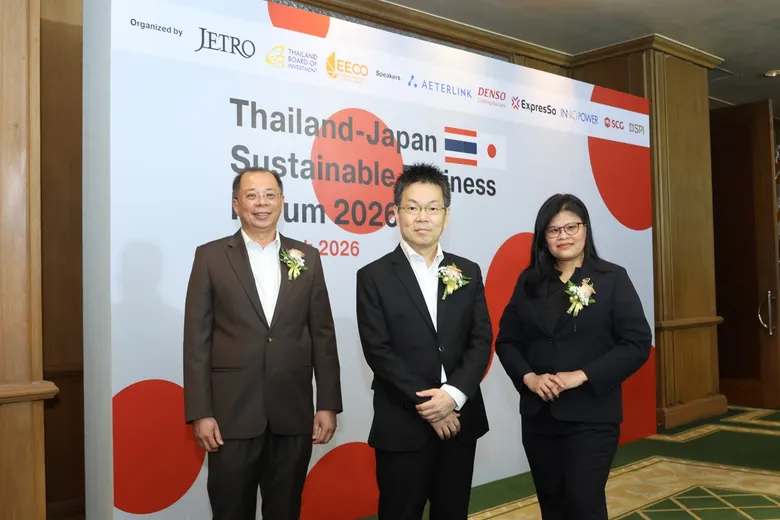
On 19 March 2026, the "Thailand-Japan Sustainable Business Forum 2026" has been co-organized by JETRO, Thailand Board of Investment (BOI), and the Eastern Economic Corridor Office (EECO) as a sustainability stage. This forum invites private organizations, playing key roles in policy, industry, and innovation sectors. Leading private companies, and Japanese startups joined to exchange information, share experiences, and build partnerships. The event features two key panel discussions: the first on "AI ? Sustainability," led by Mr. Prempreedee Kitirattrakarn, CEO, ExpresSo NB, VC of PTT; Mr. Om Kaosa-ard, Head of Venture Capital, INNOPOWER; and Mr. Niran Banleurat, Head of AI Strategy and Transformation, CBM, SCG. The second discussion, titled "Two Drivers of Sustainability - Deep Tech ? Corporate Sustainability," features Ms. Suthida Jongjenkit, President, SAHA PATHANA INTER-HOLDING and Mr. Ryo Iwasa, CEO, AETERLINK, a deep-tech startup from Japan, with Mr. Pradit Mahasaksiri, Chief New Business Innovation Officer, DENSO International Asia acting as moderator. Additionally, a "Startup Showcase" is organized to provide tangible opportunities for building business networks.
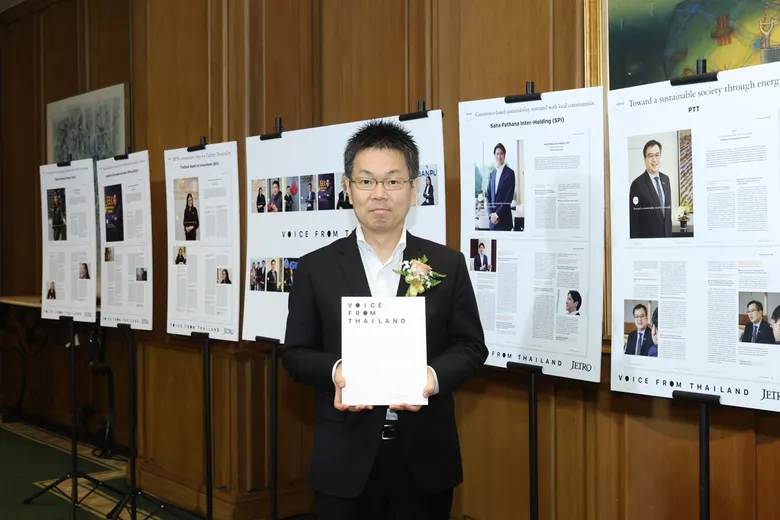
On this occasion, JETRO Bangkok also launched a special publication titled "VOICE FROM THAILAND," which compiles interviews from government agencies, Thai private sector executives, and key figures involved in Thai-Japanese cooperation. It offers in-depth perspectives on Thailand's policy direction, business strategies, and expectations for bilateral collaboration. This publication has been produced by JETRO Bangkok to serve as a bridge connecting all sectors in the sustainable development of economic and industrial cooperation that will yield long-term impacts.
Ms. Sudhasinee Smitra, Deputy Secretary General of the Board of Investment (BOI), stated at the Thailand-Japan Sustainable Business Forum 2026 that the ASEAN region is experiencing exponential growth, with Foreign Direct Investment (FDI) in the region increasing from 146 billion USD in 2018 to 226 billion USD in 2024, accounting for 15% of global FDI. Thailand is the region's growth epicenter. Equipped with world-class infrastructure, ready-to-use industrial estates, and robust supply chains, Thailand's investment promotion applications reached a decade-high in 2025, valued at 1.8 trillion baht—a 67% increase from the previous year (2024)—with over 70% coming from FDI. The core target industries include digital infrastructure, electrical appliances and electronics, as well as automotive and parts. Japanese investors remain the second-largest investor group; in 2025, they submitted 311 investment promotion applications (a 17% increase) with a total value of 119 billion baht, which is 1.4 times higher than in 2024.
Today, sustainable investment is no longer an "option" but a "competitive advantage" and the heart of national strength. Currently, the world places the highest priority on decarbonization, clean energy, and the circular economy. This aligns with the BOI's policy of promoting the BCG (Bio-Circular-Green) economy model to elevate the use of resources and biodiversity in Thailand through domestic and international technologies and innovations. There are attractive incentive measures, particularly in renewable energy and related sectors, as well as the Smart and Sustainable Industry program, which supports investment in energy storage systems for the transition to clean energy. It also encourages existing projects to transition into automated and digital systems, and to reduce energy consumption to mitigate environmental impacts.
Therefore, the collaboration in organizing the Thailand-Japan Sustainable Business Forum has become increasingly significant, reflecting the strength of a partnership advancing together. Today, as we step into the clean energy and digital transition, cooperation between the two countries is more crucial than ever, mutually supporting each other in clean energy, future mobility, AI, and bio-industries. The BOI firmly reassures that Thailand is fully prepared to support investors in navigating this transition.
Regarding the drive for investment and cooperation with Japanese investors in the EEC area, Mr. Chula Sukmanop, Secretary-General of the Eastern Economic Corridor Office of Thailand (EECO), stated that the EECO and JETRO Bangkok have collaborated since the establishment of the EEC in 2018. Both parties have played a significant role in strengthening trade and investment relations, particularly in future industry groups. Since 2024, the EECO has expanded its cooperation to support startup businesses and promote the development of new business models in target industries. A key focus is the Bio-Circular-Green (BCG) Economy, which aligns with Japan's Green Transformation (GX) policy.
Today, the EEC area is a crucial center for the transition into new-age industries. Therefore, the development strategy emphasizes upgrading industries through advanced technology, innovation, and sustainable infrastructure. This particularly involves decarbonization technologies, low-carbon energy solutions, and renewable energy, which are key factors in enhancing the manufacturing sector's competitiveness in the global economy. Sustainability is not merely about environmental conservation; it also directly impacts supply chain decision-making, global market access, and long-term investor confidence. The rapidly growing industry groups in the EEC area reflecting this transition include Electric Vehicles (EVs) and modern automotive supply chains, digital industries, Data Centers, AI-driven services, biotechnology and high-value agricultural processing, as well as green energy industries such as renewable energy, green hydrogen, waste-to-energy, and energy efficiency enhancement.
The rapid expansion of the EV and Data Center industries demands stable and green electricity, meaning investors do not solely consider infrastructure readiness, but also prioritize renewable energy and carbon management capabilities before making investment decisions. Thus, this transition creates business and collaborative opportunities between Thai companies seeking advanced green technologies and Japanese companies with expertise in energy efficiency, hydrogen technology, the circular economy, and decarbonization innovations. The EECO firmly believes that the strong cooperation between the two countries can turn challenges into opportunities.