Bangkok - 12 October 2026 - The transition to electric logistics does not begin and end with replacing internal-combustion trucks with electric vehicles. Behind every journey is a wider system that must work together - from the vehicle and charging station to sufficient power, route planning, network coverage and operators' time management. If one part is not ready, electric trucks may still fall short of the demands of commercial operations.
Huawei Digital Power Thailand and Spark EV are therefore collaborating to strengthen one of the key elements of this ecosystem: electric truck charging infrastructure. Huawei FusionCharge will serve as the charging technology standard for Spark EV's Corridor Hub project, while Spark EV will develop, invest in and operate charging hubs along the country's freight routes, connecting the technology with the real-world needs of transport routes and operators.
At the heart of the collaboration is Huawei FusionCharge, a split-type ultra-fast charging system built around a central liquid-cooled Power Unit with output of up to 720 kW. The Power Unit can supply multiple Dispensers and automatically allocate power among active charging connectors, helping the station operate efficiently even when several vehicles charge at the same time. For large trucks, the Boost Dispenser comes with a 7.5-metre charging cable designed to reach charging ports on trucks and tractor units more easily, and supports voltage of up to 1,000 V for new-generation high-voltage electric trucks. At sites where grid capacity is limited, an energy storage system connected to the station's DC bus can raise total output to the megawatt level - up to 1,440 kW - without requiring an expansion of the grid connection. The result is shorter charging stops that can fit within existing driver rest periods and loading or unloading windows in fleet schedules.*
For transport operators, charging speed alone is not the whole answer. Having a charger does not necessarily mean having a network that works for day-to-day operations. Station locations, route continuity and charging time all affect vehicle scheduling and operating costs. The collaboration therefore brings high-power charging together with network expansion along freight routes, helping build confidence for operators already running electric trucks as well as those considering transitioning their fleets to EVs.
"Fleet electrification only works when vehicles, charging infrastructure and route operations move together. High-power charging helps reduce time constraints and makes electric trucks more practical for commercial operations," said Mr. Jack Zeng, Managing Director, Digital Power Business Group, Huawei Technologies (Thailand) Co., Ltd.
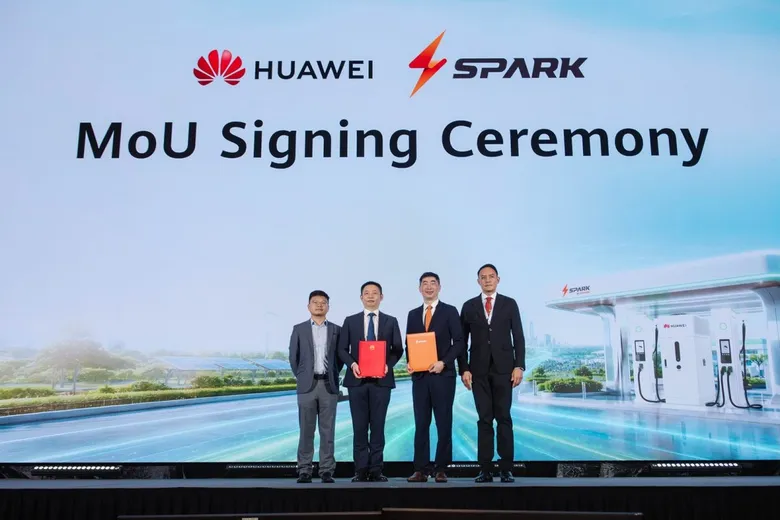
The collaboration was announced at the Huawei x Spark Green Logistics Thailand Summit 2026 - Powering Thailand's Freight Corridors, held on 30 September 2026 at The Signature Grand Ballroom, Fairmont Bangkok Sukhumvit. At the event, Huawei Digital Power Thailand and Cornerstone, the parent company of Spark EV, signed a Memorandum of Understanding (MoU) for the next phase of electric truck charging network development. The summit also brought together transport operators, truck manufacturers, energy partners and industry leaders to exchange perspectives on total cost of ownership (TCO), infrastructure and the commercial readiness of electric transport.
"Operators look beyond the truck itself. They need to know where they can charge, how long it will take and whether their routes are supported. Expanding a network around real transport patterns is key to enabling the transition to electric trucks at greater scale," said Mr. Vincent Yip, Chief Executive Officer of Cornerstone and Spark EV.
The transition to green logistics is therefore not a challenge for vehicle manufacturers alone. It requires an ecosystem in which vehicles, charging technology, route networks and fleet operations develop together. For Huawei and Spark EV, expanding charging infrastructure is another important piece of that system - helping reduce practical barriers and strengthen the readiness of Thai businesses to move toward cleaner transport.
*Actual charging performance depends on each vehicle's charging capability, battery state and operating conditions.