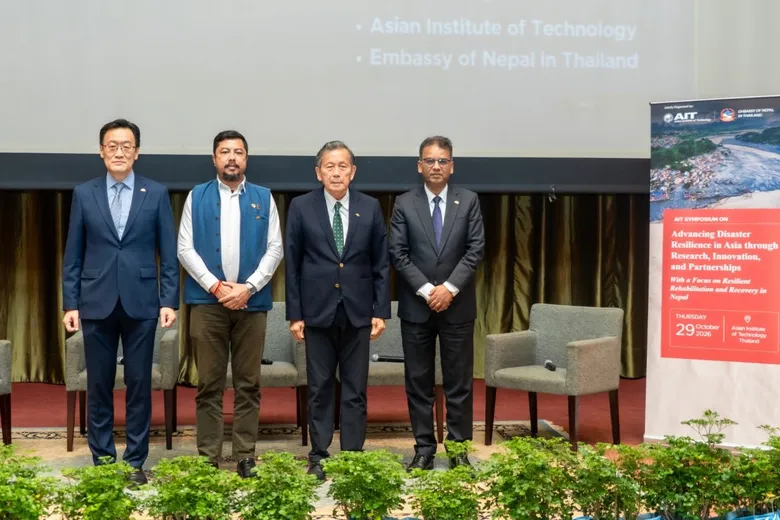
The international symposium, "Advancing Disaster Resilience in Asia through Research, Innovation and Partnerships," jointly organized by AIT and the Embassy of Nepal in Thailand on 29 October, brought together more than 220 participants onsite and online, including government leaders, researchers, disaster resilience experts, and development partners.
AIT President Prof. Pai-Chi Li emphasized that recent disasters in Nepal and Thailand demonstrate the shared nature of disaster risks across the region and the importance of connecting science, policy, and practice.
"Recovery must therefore restore not only physical assets, but also people's security and opportunities," he said, highlighting AIT's contributions through research, education, and professional training.
Twelve AIT experts presented research and innovations spanning early warning systems, satellite monitoring, artificial intelligence, resilient infrastructure, sustainable energy, agriculture, and community-centered recovery. Technologies showcased included FloodS, a flood simulation and adaptation planning tool; DUMBO Net, a portable emergency communications system; and Habitech-NivaraTantra, an affordable disaster-resilient housing and sanitation solution.
AIT also highlighted its capabilities in satellite-based damage assessment, geospatial mapping, and mobile field-data collection. Its intERLab has provided emergency communications technology and support in Nepal, demonstrating how research can be applied to real-world disaster response.
Gen. Dr. Boonsrang Niumpradit, Chairman of the AIT Board of Trustees, outlined three principles of effective disaster preparedness: anticipation, speed, and simplicity. He emphasized that early warning must lead to timely action and that preparedness measures must be understandable and practical for communities.
"Even the best technology has limited value if communities cannot understand it or institutions cannot act on it," he stressed.
Dr. Bhichit Rattakul, President of the Thai Network for Disaster Resilience, highlighted the growing complexity of climate and disaster risks across Asia, emphasizing multidisciplinary research, institutional coordination, and community participation.
The symposium also drew lessons from Nepal's recent floods. Hon. Mr. Biraj Bhakta Shrestha, Nepal's Minister of Energy, Water Resources and Irrigation, called for stronger early warning systems, climate-resilient infrastructure, and international cooperation. He highlighted opportunities for collaboration with AIT and reaffirmed Nepal's commitment to advancing the proposed AIT Center in Nepal.
The Embassy of Nepal in Thailand, as joint organizer, played an important role in bringing together government representatives, researchers, and development partners. H.E. Mr. Dhan Bahadur Oli, Ambassador of Nepal to Thailand and a member of the AIT Board of Trustees, highlighted AIT's longstanding contributions to Nepal and expressed support for strengthening cooperation in research, innovation, and capacity development.
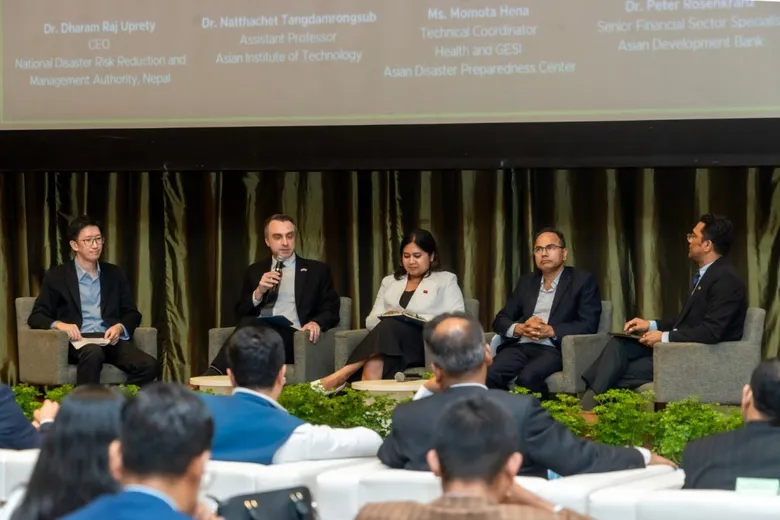
A panel featuring representatives from Nepal's National Disaster Risk Reduction and Management Authority, the Asian Disaster Preparedness Center (ADPC), the Asian Development Bank (ADB), and AIT explored resilient reconstruction, early warning, institutional coordination, and disaster risk financing.
Looking beyond the symposium, AIT Vice President for Administration and Development Prof. Siddharth Jabade outlined plans to consolidate the symposium's outcomes and document AIT's research capabilities, technologies, and training opportunities. These would support further engagement with the Embassy of Nepal and other partners to identify practical opportunities for joint research, technical assistance, and capacity development.
The symposium highlighted AIT's role as a regional platform connecting research, technology, policy, and development partners to turn disaster resilience innovations into practical solutions for communities across Thailand and the wider Asian region.