CEOs, business and HR leaders gather to confront the defining leadership challenges of the AI era
- PacRim hosted two flagship executive events — the PacRim CEO Dialogue 2026 and the PacRim CRO Summit 2026 — drawing Thailand's most influential C-suite and HR leaders for a full day high-impact discussion
- Paul Walker, FranklinCovey's global CEO, and Ronnie Tan, President of FranklinCovey Singapore, Hong Kong & Taiwan, headlined the CEO Dialogue with insights from working alongside hundreds of global organizations through disruption and transformation
- Research reveal high-trust organizations are 11x more innovative and 6x more likely to hit performance targets — reframing trust as a hard economic lever, not a soft leadership ideal
PacRim Group, Thailand's leading leadership, people and performance improvement consultancy, recently hosted two landmark executive events — the PacRim CEO Dialogue 2026 and the PacRim CRO Summit 2026 — bringing together some of Thailand's most influential leaders for candid, high-impact discussions on navigating an era of unprecedented disruption.
Held under the theme "Navigating the Unknown — Where Are All the Great Leaders?", the CEO Dialogue convened a select group of C-suite executives for a morning of unfiltered conversations anchored in real-world leadership experience. The afternoon CRO Summit, themed "Unlocking Gen Z's Potential," turned the lens toward the talent pipeline challenge every organization is wrestling with today.
A Morning of Rare Candor from Global Leadership Voices
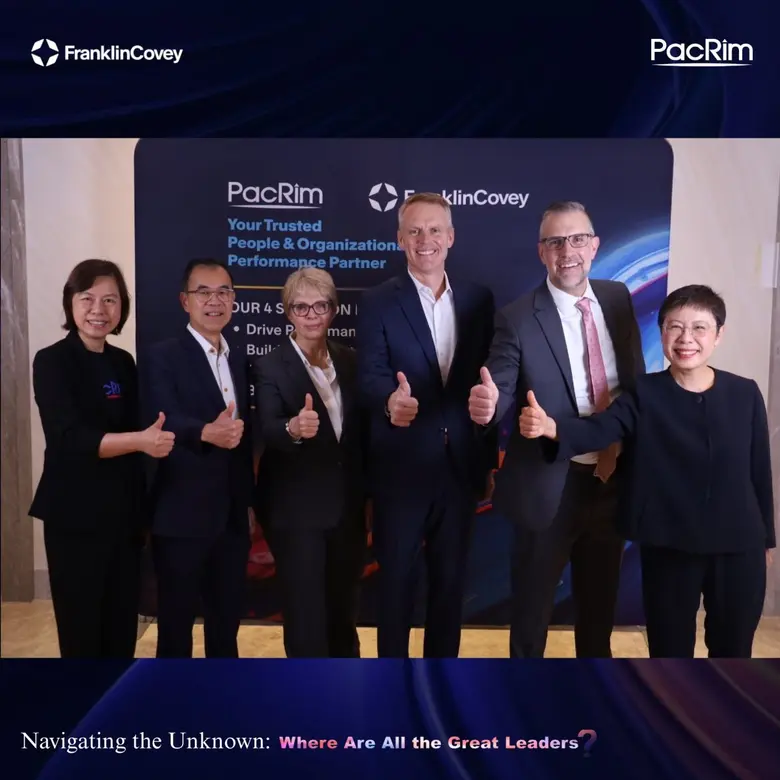
The CEO Dialogue featured two distinguished guest speakers: Paul Walker, global CEO of FranklinCovey, and Ronnie Tan, President of FranklinCovey Singapore, Hong Kong & Taiwan — both speaking from decades of working alongside some of the world's best organizations through change, crisis, and reinvention.
Three Themes Emerged:
- Turning Uncertainty into Strategic Advantage
Paul Walker challenged the room with a striking statistic: 87% of leaders view disruption as something to survive — but the outlier 13% see it as fuel for transformation. Drawing on Walmart's ongoing reinvention under former CEO Doug McMillon, Walker highlighted the leadership qualities that distinguish this minority: curiosity, courage, and empathy. " McMillon gathered his entire workforce and told them: almost everything at Walmart will change. Two things won't — our mission and our values. That kind of radical transparency builds the trust that makes transformation possible," Walker said.
Ronnie Tan brought a regional lens from Singapore, citing how the city-state's best companies — from major banks to heavy industry — have learned to disrupt themselves before external forces do. "In Singapore, companies don't wait for change. They ask: what part of my business do I need to disrupt 'right now', while we're still doing well? That's a mindset thing."
- Building Resilience with Alignment and Trust
Trust emerged as the session's defining theme. Walker cited research showing that high-trust organizations are 11 times more innovative and 6 times more likely to hit their performance targets — reframing trust from a "soft" concept into a hard economic lever. He shared the story of a major technology company whose transformation stalled not for lack of strategy, but because its top 12 leaders didn't truly trust one another. "The best ideas come from within our organizations — but only in environments where people feel safe to bring them," Walker said.
FranklinCovey's foundational framework, Leading at the Speed of Trust, and its 13 high-trust behaviors were introduced as practical, measurable tools — not abstractions. Walker was emphatic: "You can't build trust by talking about trust. You can only build it by behaving your way into it."
Ronnie Tan traced Singapore's hard-won institutional trust to decades of transparent governance and disciplined execution. His metaphor resonated throughout the room: building trust is like growing a tree — it takes years to grow and minutes to cut down. "But even if you've cut it down, if the roots are still there, it can grow again."
- Igniting Human Capability in the AI Era
The session's final theme was the most provocative. As AI reshapes every function and role, Walker pushed back on the prevailing anxiety: "The more helpful AI becomes on its side of the equation, the more of a premium it places on the most human of human skills — judgment, empathy, the ability to move people from here to there." He cited a global tech company's recent course correction: having initially said it would stop hiring junior employees, the company reversed course, recognizing that without investing in the next generation, its leadership pipeline would run dry.
Tan echoed Apple CEO Tim Cook's warning that the real risk isn't AI replacing people — it's people surrendering their humanity to AI. "Every era of technological change has made us better because humans chose to harness it, not be harnessed by it. AI is no different."
From Global Principles to Local Practice: Session Two of the CEO Dialogue
The CEO Dialogue continued into a second session, shifting from global leadership philosophy to on-the-ground execution. Khun Kamonsak Reungjarearnrung, COO of RSU International Hospital, and Khun Vatsun Thirapatarapong, Country Manager of Amazon Web Services Thailand, joined the stage moderated by PacRim Senior Consultant Khun Manrat Praditwongsin.
The panel unpacked transformation from the inside — from deploying robotics in hospital pharmacies to voice-over-IP disruption in telecoms — while confronting the people dimensions of change that often derail even well-resourced initiatives. A standout insight: 92% of healthcare professionals surveyed say they plan to leave within three years — a wake-up call for any industry operating on legacy talent strategies.
Khun Vatsun introduced Amazon's four-pillar Culture of Innovation framework, noting that innovation at scale comes not from R&D budget alone but from embedding the right behaviors into every organizational routine. Khun Kamonsak shared a three-part Individual Development Plan model that tracks talent readiness against both immediate organizational needs and long-term individual aspirations — including helping employees plan for futures that may take them beyond the organization.
Bridging the Generational Divide
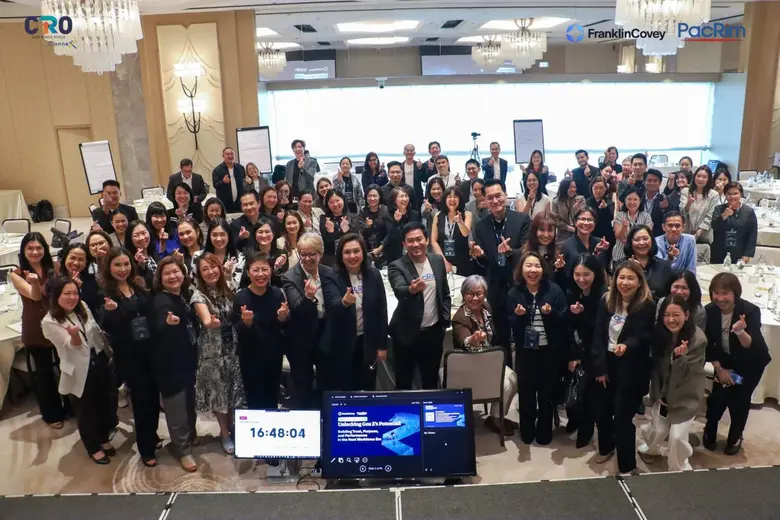
In the afternoon, the PacRim CRO Summit 2026 gathered more than 70 HR leaders to address the "Generational Divide." Vanee Bijayendrayodhin, Senior Consultant at PacRim Group, and Jolanda Prijs, General Manager of FranklinCovey International Network, emphasized shifting from managing differences to unlocking synergy. The session provided a roadmap for bridging gaps between Gen Z and established leadership to ensure diverse strengths translate into measurable execution.
The "Root" of Great Leadership
Closing the day, Porntip Iyimapun offered a profound metaphor for the future: "A tree with a strong root can withstand storms. Storms are inevitable and we cannot predict the future, but we can build a strong foundation for our people. That root is built on trust and humanity."
She challenged the executives in attendance with a final reflection: "What fundamental shift will you make in your leadership today to be the leader your organization needs tomorrow?"