Chusuwan, Chalit Nakpawan, Ing K, Manit Sriwanichpoom, Namfon Laistrooglai,
Nino Sarabutra, Pairoj Teeraprapa, Supicha Sorndamrih, Thiwawat Pattaragulwanit, Tul
Hirunyalawaan and Vipavee Kunavichayanont
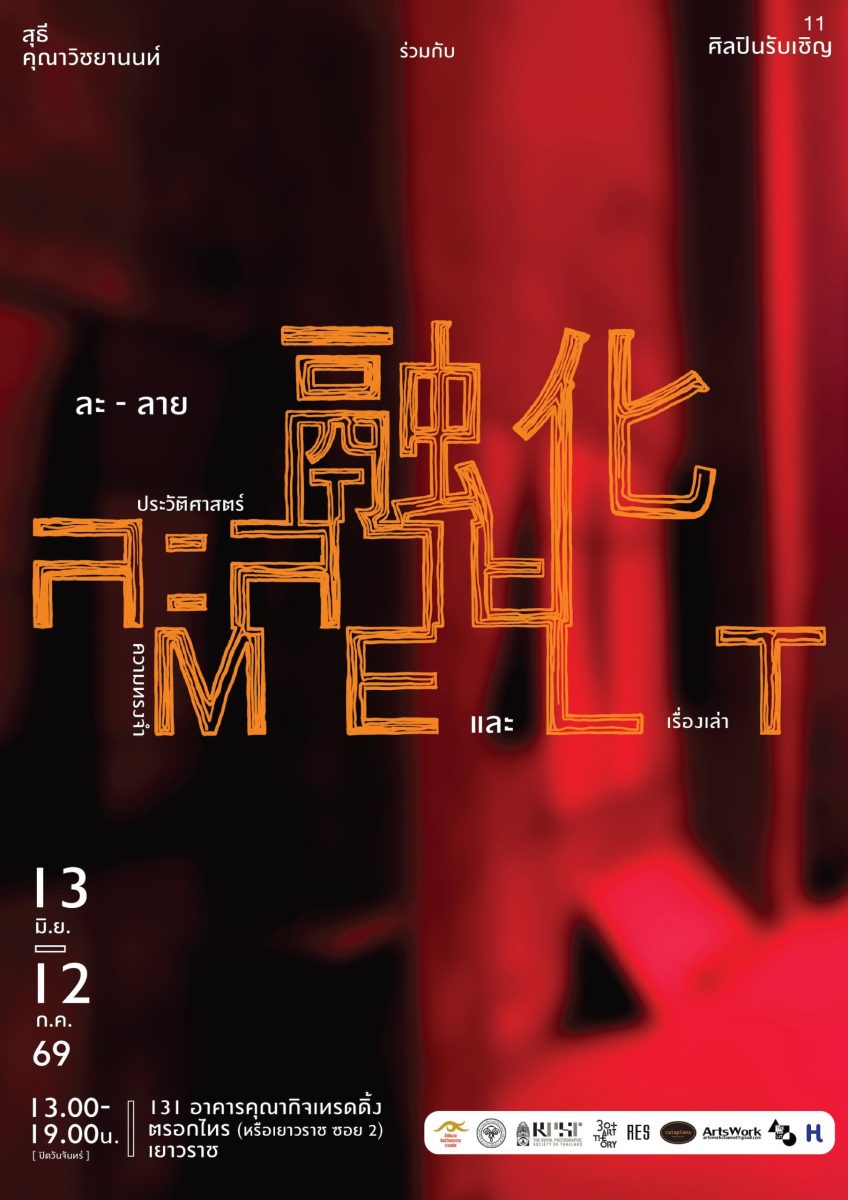
Opening Reception
Saturday 13 June 2026, 16.00-19.00 hrs.
Exhibition: 13 June - 12 July 2026, 13.00-19.00 hrs. (Closed Mondays)
131 KUNAKIJ Trading-The Historical Building, Entrance via Yaowarat Road Soi 2 or Trok
Sai (Texas), Bangkok
https://share.google/DsNYfRhn2kXshP9pI
Please note that parking is not available at the venue.
Recommended parking: I'm Chinatown: https://maps.app.goo.gl/C4fJMyBuGpDgvCMy9
MELT (2022-2026)
MELT is a body of work developed from Sutee Kunavichayanont's personal photographic archive—630 rolls of 35 mm negative film, comprising approximately 22,680 images taken between the 1980s and the mid-2000s. These photographs once functioned as small, intimate records of daily life, artistic practice, and lived experience. Over time, however, the chemical base of the film deteriorated. Heat and duration caused the images to melt, distort, and eventually disappear.
Rather than restoring or preserving the damaged negatives, Sutee chose to work with their decay. The process of melting becomes both material and method. As the images dissolve, photography loses its role as evidence. What remains are chemical traces, abstract surfaces, and fragments of memory. In this sense, MELT shifts photography away from representation and toward a reflection on loss and transformation.
The work explores the relationship between memory, narrative, and history across multiple scales. The personal images recorded on these films represent small narratives—private moments, minor events, and subjective experiences. Yet among them are images of places and events embedded in collective memory, such as Ground Zero in New York, the Democracy Monument in Bangkok, and the Hellfire Pass Memorial in Kanchanaburi. As these negatives dissolve, personal memory and grand historical narratives erode together.
MELT questions the assumption that images can permanently secure memory or history. If photographs—often trusted as reliable witnesses—are themselves unstable, what does this suggest about the story's societies choose to remember, and those that are allowed to fade? The work does not attempt to reconstruct what has been lost. Instead, it accepts impermanence as an unavoidable condition of time.
MELT invites viewers to consider what remains when images disappear: how memory persists beyond visibility, and how history continues to exist even as its material traces dissolve.
More Information
- Exhibition 13 June- 12 July 2026
- Opening Saturday 13 June,2026 4 pm-7 pm
- 131 KUNAKIJ Trading-The Historical Building, Entrance via Yaowarat Road Soi 2 or Trok
Sai (Texas), Bangkok https://share.google/DsNYfRhn2kXshP9pI